Twilight Struggle
- 4.0
- Rating
- 50.00K
- Installs
- $9.99
- Price

 Analysis by App-foxy
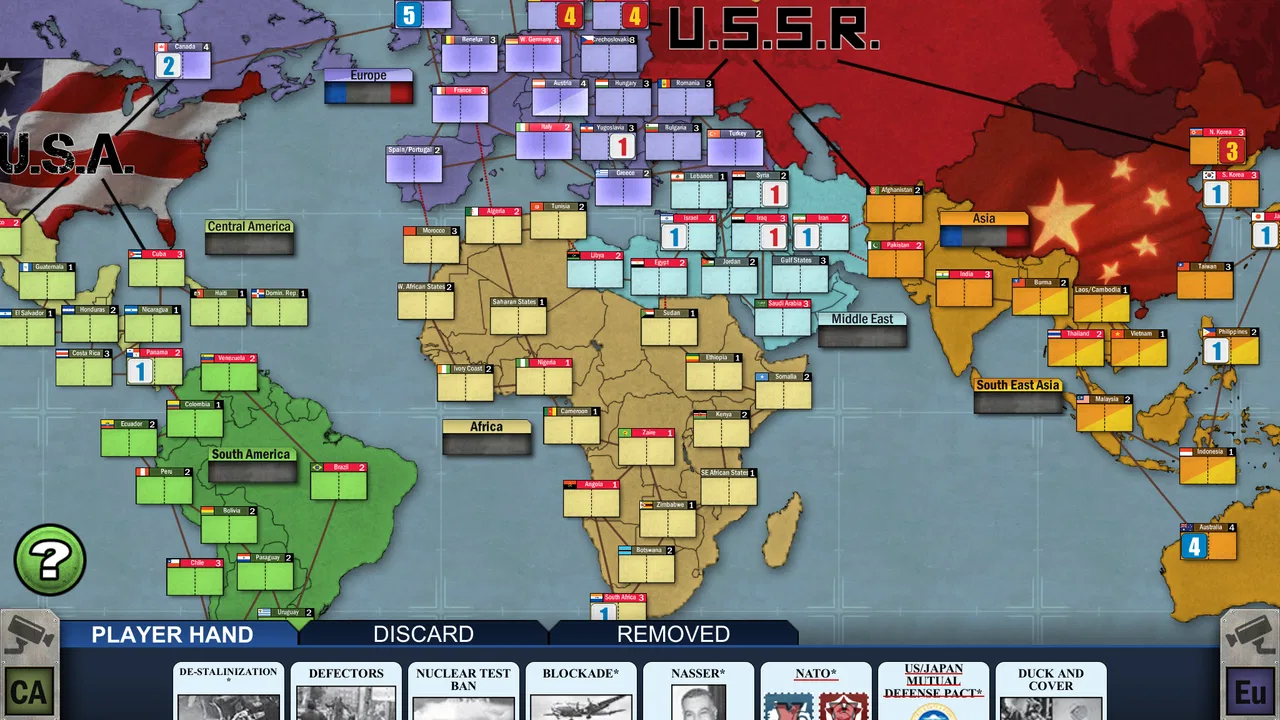
Twilight Struggle is the kind of board game I open when I want a serious contest rather than a quick distraction. It turns the Cold War into a tense struggle of influence, timing, and risk, with the United States and Soviet Union competing across a changing world. I found it demanding, sometimes unforgiving, but unusually rewarding once I stopped treating every turn as a race for immediate points.
This is a paid board game from Playdek, Inc., aimed at players who enjoy planning several moves ahead. It costs $9.99, carries an Everyone 10+ age rating, and has a 4.0 average from around 1.7K ratings. Those numbers suggest a fairly clear audience: people who already like thoughtful digital board games will probably understand the appeal, while anyone looking for a casual, instantly readable experience may need patience before it clicks.
How the Cold War workflow feels in practice
I use the first few turns to settle into the game’s rhythm: check which regions may score, weigh each card’s event against its operations, and decide which vulnerabilities can wait. That routine helps me avoid spending every move on the most obvious threat. It also sets up the next question: how to keep those decisions manageable as the board grows more complicated.
You May Also Like

 Blood Strike: 2.5 Anniversary
Blood Strike’s Loadouts Turn Every Drop Into a Tactical Gamble
A close look at Blood Strike’s custom loadouts: how fast access to signature weapons reshapes its battle royale rhythm, rewards preparation, and narrows the gap between fights.

 Pandora - Music & Podcasts
Pandora’s Music Is Easy to Start, but Harder to Recover
Pandora’s strength is its low-effort path from a seed to a station. Its weak spot is how much confidence it asks you to place in connection, setup, and quiet recovery.

 8 Ball Pool
 Is Built on Rivalries, Rematches, and Routine
A close look at the rivalries, rematches, shared routines, and unanswered safety questions that turn a quick pool match into a persistent mobile community.

 Samsung Music
’s Quiet Strength Is Playing What You Already Own
Its reach comes less from spectacle than from dependable access to a personal library. That simplicity is both the app’s strongest retention engine and its ceiling.

 AccuWeather: Weather Radar
AccuWeather Review: A Quick, Clear Forecast for Everyday Decisions
For everyday plans, the best forecast is the one you can understand quickly. AccuWeather makes rain timing, radar, and local conditions easy to act on, with a few trade-offs.

 Hill Climb Racing
Why Hill Climb Racing Still Turns Crashes Into One More Run
A tiny car, a bumpy hill and one more upgrade: Hill Climb Racing keeps resurfacing because its simple chaos makes every near-miss feel personal.
More From Our News Desk
View All News


Start by learning the rhythm, not memorizing everything
My first useful adjustment was to stop trying to understand every card and country at once. The game becomes easier to read when I divide a turn into a few familiar questions: where is influence already established, which regions are close to scoring, and which events could change the balance before the round ends? That simple routine gives each card a purpose even when its text is unfamiliar.
The central experience is not just placing influence. Every card creates a decision about whether to use its operations value or allow its event to happen. That choice gives the game its personality. A card associated with the opposing superpower can still be useful for operations, but playing it may also trigger an event that helps the other side. I learned to think of these cards as delayed problems rather than automatically bad draws.
A realistic evening session might begin with a player securing a few reliable positions, then spending the middle of the turn reacting to coups, realignment attempts, and regional pressure. By the end, the important question is often not “How do I gain the most now?” but “Which loss can I afford to accept?” That shift is what separates this from a simple territory-capture game.
The digital format helps with the bookkeeping that can slow down a physical version. Influence totals, card handling, and turn progression are easier to manage when the app keeps the board organized. I still need to pay attention, though. Automation reduces manual errors; it does not explain why a particular move is strategically sensible.
Use the board as a set of connected risks
New players often look for isolated strongholds. I found it more useful to see the map as a network. A country can matter because it borders a key battleground, supports a scoring region, or gives access to a later coup. A move that appears small may be valuable because it changes the number of places the opponent must defend.
That makes the game especially interesting for players who enjoy indirect pressure. I may not need to dominate an entire region. Sometimes forcing my opponent to spend cards defending several vulnerable positions is enough. Other times, spreading too widely leaves me unable to protect the countries that actually decide the scoring card.
One practical habit is to pause before committing operations and identify the next likely scoring area. I ask myself whether the current move improves my position there, blocks an opponent’s route, or merely feels productive. That last category is dangerous. Influence placed without a clear purpose can become wasted tempo.
Why the opening can feel harsh
The early game has a steep learning curve because the value of a card depends heavily on context. A card that looks weak in isolation may be excellent when it prevents an opponent from establishing control. A powerful event may be awkward if playing it exposes a region or gives away the initiative.
I would not judge the game after a single confused match. The first sessions are partly about building a mental library of recurring situations. Once I recognized which regions tend to become contested and which actions can sharply swing momentum, the board stopped looking like a collection of unrelated numbers.
The app is therefore better suited to deliberate play than to idle tapping. I enjoy it most when I have enough uninterrupted time to consider consequences. If I only have a few spare minutes and want immediate feedback, a lighter board game is a better fit.
Settings and habits worth checking
Before settling into regular matches, I recommend reviewing the available game and interface settings rather than accepting the default flow automatically. The useful goal is not to make the game easier, but to make the presentation match the way I think. Clear turn progression and readable card information matter more here than decorative polish because a missed detail can change an entire decision.
I also prefer taking a moment to inspect the board after an important event resolves. Experienced players can move quickly because they know what to scan: scoring regions, unstable battlegrounds, and any newly exposed access point. That short inspection is more reliable than rushing directly into the next action.
Another good habit is to treat the end of a turn as a reset point. I mentally review who gained regional control, which cards have already appeared, and whether the opponent’s recent actions reveal a priority. I do not need a written spreadsheet to benefit from this. A consistent thirty-second review often prevents me from repeating the same defensive mistake.
Because the game is built around uncertainty, I avoid assuming that a familiar setup guarantees a familiar result. Settings can make the experience more comfortable, but they cannot remove the need to adapt. The strongest workflow is flexible: establish a plan, watch what the cards and opponent do to it, then revise without clinging to the original idea.
Faster patterns for experienced players
Speed in this game comes from reducing unnecessary thought, not from clicking rapidly. I try to classify each card immediately: urgent event, useful operations card, dangerous opponent event, or flexible option. This first pass narrows the decision space and keeps me from rereading every possibility equally.
When I have several possible operations, I compare them by consequence rather than by raw size. A smaller placement that protects a scoring position may be stronger than a larger placement in a region that is unlikely to matter soon. This is one of the most useful repeatable patterns I found because it prevents attractive but strategically empty moves.
I also separate “must answer now” threats from “can tolerate for one round” threats. Trying to repair every weakness immediately usually spreads influence too thin. Sometimes the correct response is to accept a temporary disadvantage and use the turn to create pressure somewhere else. That trade-off is uncomfortable, but it is central to playing efficiently.
Another shortcut is to track initiative. If I have just forced the opponent to respond, I look for ways to preserve that pressure. If the opponent has created the threat, I avoid spending my best options on a minor correction unless it prevents a much larger swing. Thinking in terms of who is reacting makes the sequence of actions easier to evaluate.
When the game works well for two people
This is primarily a head-to-head experience, and that focus is a strength. The contest feels personal without requiring a large group, making it suitable for a quiet evening with a friend who enjoys strategy. It also works for solo practice when I want to test openings, compare approaches, or become more comfortable with the flow before challenging another person.
The trade-off is that the game does not provide the social looseness of party-oriented board games. There is little room for players who want constant conversation, fast turns, or a forgiving atmosphere. A thoughtful opponent can make the experience fascinating; an opponent who rushes or treats every setback as frustrating may find the tension exhausting.
I would also avoid recommending it as a first board game for someone unfamiliar with card-driven strategy. The rules are learnable, but the important lessons emerge through play. Players who prefer immediate certainty may feel that the game is punishing when it is actually asking them to manage incomplete information.
Advanced limits: where skill meets uncertainty
No workflow eliminates the role of luck. Cards can create awkward situations, and a carefully prepared position may still be disrupted. I appreciate that uncertainty because it keeps matches from becoming identical, but it also means a loss does not always reveal one obvious mistake. Reviewing the whole sequence is more useful than blaming the last event.
The game can also punish overconfidence. A player who assumes that a strong regional position is permanent may overlook a scoring card, a coup opportunity, or a sudden change in access. I have had better results when I treat control as something to maintain rather than something to possess forever.
One advanced limit is information overload. As the match develops, remembering every discarded event, every exposed weakness, and every possible scoring concern can become difficult. The answer is not to calculate everything. I focus on the few facts that can change the next decision: contested battlegrounds, likely scoring regions, and whether the opponent is building toward a visible objective.
This selective attention is also why the game rewards repeat play. A beginner may see randomness; a more experienced player sees a limited set of recurring tensions. The uncertainty remains, but the response becomes more informed. That is a satisfying form of progression because it comes from better judgment rather than simply unlocking content.
How it compares with lighter board-game alternatives
Compared with a typical mobile board game built around quick rounds and obvious rewards, this app asks for much more concentration. It has fewer moments of effortless progress, but its decisions carry greater weight. I would choose it over a casual alternative when I want a match to stay interesting after the rules are familiar.
It is also different from abstract strategy games that use symmetrical pieces and fully visible information. The Cold War theme matters because the board is shaped by historical events and uneven possibilities. That creates atmosphere, but it also means the game can feel less clean and predictable than a purely mathematical contest.
Physical board-game fans may prefer a tabletop version for conversation, shared components, and the ritual of moving pieces. The app is more convenient and handles administration, which makes it easier to practice or play without setting up a table. I see it as a strong digital way to engage with this design, not necessarily a replacement for every reason people enjoy the physical format.
Who should buy it, and who should skip it
I recommend it to players who like historical themes, card-driven decisions, and matches where a modest action can have consequences several turns later. It is especially good for someone who enjoys reviewing a loss and thinking, “I should have protected that region earlier,” rather than simply wanting to move on to the next round.
It is less suitable for children or casual players despite the Everyone 10+ rating, because the age label does not communicate the strategic difficulty. A younger player who already enjoys serious board games may be fine, but the game is not designed around instant accessibility.
I would also skip it if I mainly want a relaxing game with low stakes, a short learning curve, or constant visual excitement. The $9.99 purchase makes more sense when I expect to return repeatedly. There are in-app purchases priced at $1.99 per item, so I would consider the overall cost before buying if I prefer games with no additional spending decisions.
Version, device expectations, and long-term value
The current version is 1.4.10, and it requires Android 6.0 or later. That makes checking device compatibility a sensible step before purchase. I found the game most comfortable on a screen where card text and the map remain easy to inspect, since strategic decisions depend on details that are not ideal to skim.
Its long-term value comes from replayability rather than a constant stream of new distractions. Different card sequences, changing priorities, and human opponents can make the same broad scenario feel different. The installed base is over 50K, and the game has around 202 written reviews, which points to an established but specialized audience rather than a mass-market time-killer.
That specialization is important. The app does not need to appeal to everyone to be worthwhile. Its value depends on whether I enjoy studying positions, accepting imperfect information, and making plans that may need to change. For that audience, the price can be reasonable because one good match offers more depth than many disposable mobile sessions.
My verdict after building a repeatable routine
Twilight Struggle became much more enjoyable once I stopped measuring success by immediate territorial gains. My reliable routine is to inspect scoring risks, classify the cards, protect only the weaknesses that truly matter, and review the board before ending each turn. Those habits make the interface easier to use and the strategy easier to understand without pretending that every outcome can be controlled.
The limitations are real: the learning curve is steep, luck can create uncomfortable turns, and the experience is too demanding for players seeking a quick casual diversion. The additional purchase model may also make some buyers hesitate. Still, none of those issues undermine the core design for its intended audience.
My recommendation is straightforward: choose this if you want a deep two-player board game that rewards repeated study, not instant comfort. I would happily suggest it to a friend who enjoys tense decisions and historical strategy. I would steer a casual player toward a lighter alternative, but for someone willing to learn its patterns, this remains a compelling digital Cold War contest with enough depth to justify returning to the table again and again.
FAQs for Twilight Struggle
01What is Twilight Struggle, and what kind of game is it?
Twilight Struggle is a two-player digital adaptation of the acclaimed Cold War board game. One player controls the United States while the other leads the Soviet Union, competing for global influence through political events, military pressure, coups, and realignment operations. It is a strategy game focused on planning, risk management, historical events, and long-term decision-making rather than fast action.
02Can I play Twilight Struggle offline or without another person?
Yes, Twilight Struggle is designed to support different ways of playing, although the exact options can depend on the platform and version you download. You can generally challenge an artificial intelligence opponent for solo practice, while multiplayer modes let you compete against another person. Before downloading, check the store listing for current online requirements, account features, and whether every mode is available offline.
03Is Twilight Struggle suitable for beginners?
Twilight Struggle can be enjoyed by newcomers, but it has a considerable learning curve. Players must understand influence placement, scoring cards, headline choices, military operations, and the consequences of triggering historical events. The interface helps manage the rules, yet learning effective strategy takes several matches. Beginners should start with the tutorial or introductory guidance and expect to make mistakes while learning.
04Does the game include real Cold War history?
Yes. Historical events are central to Twilight Struggle rather than being simple background decoration. Cards represent major political, military, and diplomatic developments from the Cold War, and playing them can create advantages or unintended consequences. This gives the game an educational atmosphere while preserving strategic tension. However, the experience is still a competitive board game, so outcomes may differ from real history.
05What should I know about the app before downloading Twilight Struggle?
Twilight Struggle is best suited to players who enjoy thoughtful, turn-based strategy and are willing to read rules and card effects carefully. Matches can take time, especially while learning, and the game may feel slow if you prefer quick action or casual puzzles. Review the current store information for device compatibility, pricing, multiplayer availability, updates, and any platform-specific limitations before installing.
Pros
- Faithfully captures the Cold War’s political tension and historical atmosphere.
- Asymmetric U.S. and Soviet strategies create varied
- challenging matches.
- Card-driven events make every turn feel consequential and unpredictable.
- Strong replay value from multiple paths to victory and shifting global influence.
- Suitable for serious strategy fans seeking a deep
- thoughtful board-game adaptation.
Cons
- The rules and scoring system can feel overwhelming for newcomers.
- Matches may take a long time
- especially when players analyze every decision.
- Luck from card draws can occasionally undermine carefully planned strategies.
- The interface may feel dense on smaller phone screens.
- Best experience requires learning historical cards and their strategic context.

Twilight Struggle
Gallery